
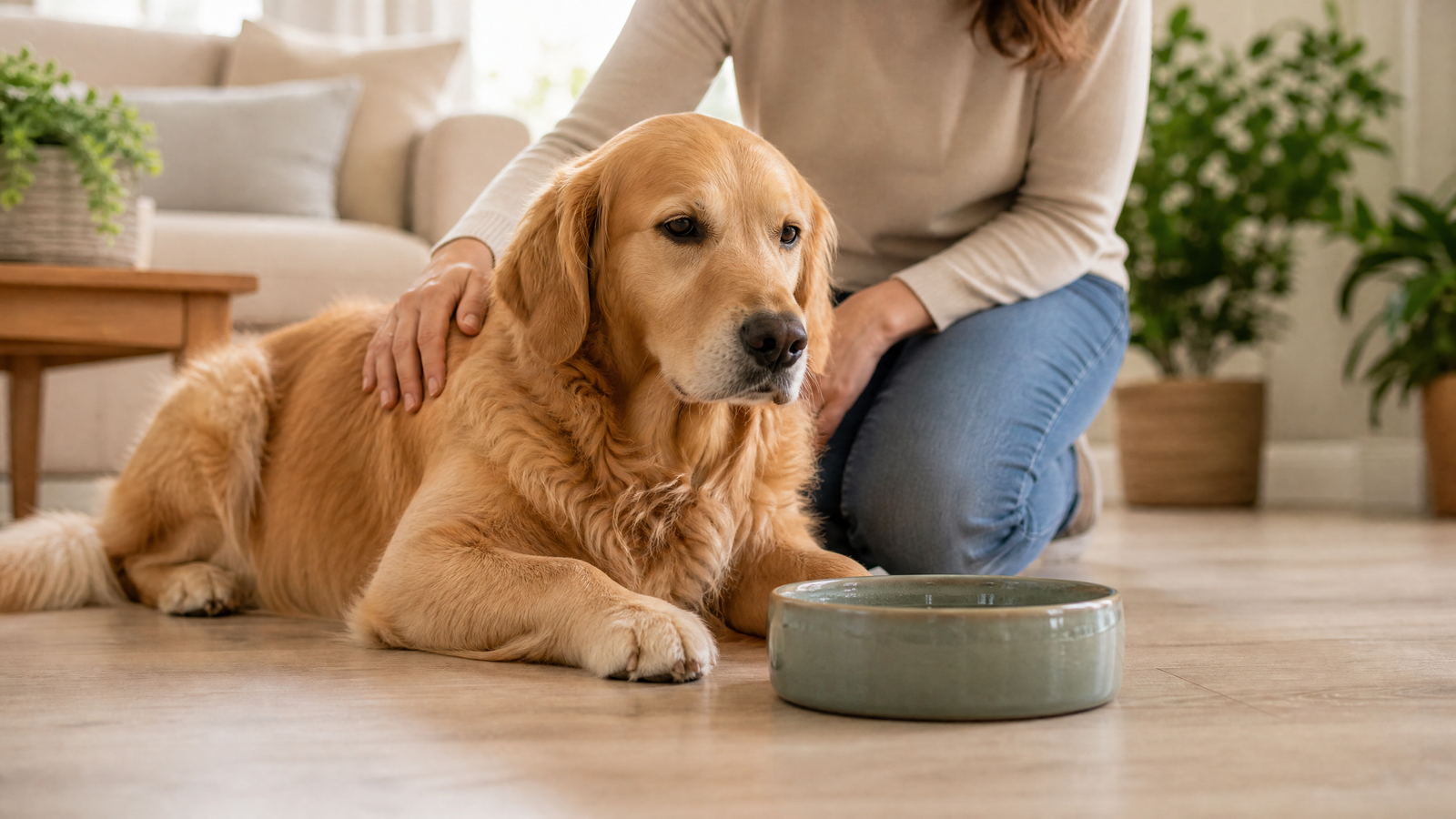

TL;DR: Dog constipation treatment depends on the cause. If your dog is otherwise comfortable and the problem is recent, offer fresh water, moisture rich food, gentle walks, and only veterinarian approved fiber. Call a veterinarian sooner for pain, vomiting, a swollen belly, repeated unproductive straining, or no stool for 48 hours.
Key Takeaways
-
Start With Safety
Constipation can resemble a blockage or even a urinary emergency. Pain, vomiting, swelling, weakness, or repeated unproductive straining calls for prompt veterinary care.
-
Hydration Comes First
Fresh water and added meal moisture may help a mildly constipated dog that is otherwise acting normal. Dehydration makes retained stool harder and more difficult to pass.
-
Fiber Is Not Universal
Some dogs benefit from added fiber, while others need a different diet. Ask your veterinarian before adding pumpkin, psyllium, or another fiber source.
-
Skip Human Remedies
Do not give human laxatives, mineral oil, or an enema unless your veterinarian specifically directs you. The wrong remedy can delay care or cause harm.
-
Prevent Repeat Episodes
Consistent water intake, suitable nutrition, daily activity, and regular bathroom access support normal stool. Recurrent constipation deserves a veterinary workup.
Dog constipation means stool is difficult or infrequent to pass. The longer stool remains in the colon, the more water the colon can absorb from it, which can make the stool dry, firm, and even harder to move. Mild cases may improve with simple support, but persistent or painful cases need a diagnosis rather than another home remedy. VCA Animal Hospitals explains how retained stool can become hard and dry.[1]
This guide focuses on safe first steps, warning signs, and the questions that help your veterinarian find the cause. It does not replace an examination, especially if your dog is distressed or may have swallowed a bone, toy, fabric, or another object.
Signs and Symptoms of Dog Constipation
The clearest signs are repeated straining, small hard stools, or no stool despite several attempts. A constipated dog may circle, squat often, scoot, cry, or seem reluctant to assume a normal bathroom posture. Some dogs pass a little liquid or mucus around a firm mass, so constipation can occasionally look like diarrhea. The VCA clinical overview describes these patterns and the possibility of liquid stool around retained feces.[1]
Watch the whole dog, not only the stool. Reduced appetite, vomiting, lethargy, weight loss, a tense abdomen, or pain when the belly or lower back is touched makes the situation more concerning. PetMD also advises prompt veterinary contact when constipation occurs with pain, loss of appetite, reduced thirst, vomiting, or lethargy. Review PetMD guidance on dog constipation symptoms and timing.[2]
A normal schedule varies. Many dogs defecate at least once each day, often around meals and walks. What matters most is a meaningful change from your dog's usual pattern combined with effort, discomfort, or abnormal stool.

When Dog Constipation Is an Emergency
Dog constipation becomes urgent when it comes with severe pain, repeated vomiting, marked lethargy, abdominal swelling, collapse, blood, or a known chance that the dog swallowed something. These signs can occur with obstruction or another serious condition that home care cannot safely rule out.
Repeated squatting can also reflect trouble urinating rather than trouble defecating. A dog that strains but produces little or no urine needs immediate veterinary care. When you are uncertain which function is affected, treat the situation as urgent.
Timing guidance varies because symptoms matter. The American Kennel Club recommends contacting a veterinarian if the problem continues beyond about 24 hours, while VCA advises calling when a dog has not produced a bowel movement within 48 to 72 hours. See the American Kennel Club overview of dog constipation treatment and escalation.[3] See VCA guidance on the 48 to 72 hour threshold.[1] A practical rule is to call sooner when your dog is straining, uncomfortable, very young, elderly, medically fragile, or acting unlike normal.
| Situation | What You May Notice | Safest Next Step |
|---|---|---|
| Recent mild difficulty | One missed stool, mild effort, normal energy, normal appetite, no vomiting | Call your veterinary clinic for advice and use only gentle support if they agree |
| Persistent constipation | Repeated straining, hard pellets, reduced appetite, or no improvement within a day | Arrange a veterinary examination promptly |
| Possible obstruction | Vomiting, painful or swollen abdomen, weakness, or possible foreign object ingestion | Seek urgent veterinary care now |
| Possible urinary emergency | Frequent squatting with little or no urine | Seek emergency veterinary care now |
7 Safe Dog Constipation Treatment Steps at Home
Safe home care is limited to a recent, mild episode in a dog that is comfortable, alert, eating, drinking, urinating, and not vomiting. If any part of that description is untrue, contact a veterinarian before trying these steps.
1. Confirm What Is Happening
Observe one bathroom attempt closely. Note whether your dog passes stool, urine, mucus, blood, or nothing. Record the last normal bowel movement, any diet changes, medications, chewed objects, bones, and changes in water intake. This short history can help your clinic assess urgency.
2. Offer Fresh Water
Keep clean water available and refresh the bowl. Adequate hydration supports normal stool moisture, while dehydration can contribute to hard retained feces. If your dog refuses water or cannot keep water down, call your veterinarian instead of forcing fluids. For a closer look at hydration clues, review these dog dehydration symptoms and recovery tips.
3. Add Moisture to the Regular Meal
If your dog is eating normally and your veterinarian has no diet restriction in place, mix a little warm water into the usual food or offer the usual canned version. Keep the meal familiar. A sudden menu change can create more digestive upset and make it harder to understand the cause.
4. Take a Gentle Walk
A calm walk gives your dog time to move, sniff, relax, and use a familiar bathroom area. The American Kennel Club notes that longer or more frequent walks may help prevent constipation. Review the American Kennel Club prevention guidance.[3] Stop if your dog is weak, painful, overheated, or unwilling to continue.
5. Ask Before Adding Fiber
Plain canned pumpkin or another fiber source may help some dogs, but it is not right for every cause. VCA notes that either a lower fiber or higher fiber diet may be needed depending on the individual dog. See VCA guidance on individualized dietary management.[1] Ask your veterinarian whether fiber is appropriate and how much to use. Before adding a topper or powder, review our guide to fiber for dogs and safe sources and ask your veterinarian which approach fits the cause.
6. Provide Easy Bathroom Access
Offer several relaxed bathroom breaks in a safe, quiet place. Dogs may hold stool because of anxiety, routine changes, painful joints, or difficulty reaching their normal area. Senior dogs may need a shorter path, better traction, or more time to find a comfortable posture.
7. Set a Clear Stop Point
Home support should produce prompt improvement, not become a multiday experiment. Call your clinic if your dog keeps straining, seems uncomfortable, develops another symptom, or does not pass a normal stool. Early care is usually simpler than treating a dry, impacted mass later.

What Not to Give a Constipated Dog
Do not give a human laxative, stool softener, suppository, mineral oil, or enema unless your veterinarian has prescribed the exact product and directions. Veterinary treatment depends on the cause, hydration status, and whether an obstruction has been ruled out. The American Kennel Club specifically warns that enemas should not be given at home. See the American Kennel Club treatment cautions.[3]
Avoid guessing with large amounts of pumpkin, bran, or psyllium. More fiber is not always better, especially when stool is already impacted or the dog is dehydrated. Fiber also cannot remove a swallowed object, correct a pelvic narrowing, relieve prostate disease, or treat painful arthritis.
Do not offer bones as a digestive aid. Bone fragments and other indigestible material are recognized causes of constipation and obstruction. VCA recommends limiting access to bones in dogs with constipation risk. Read VCA guidance on dietary causes and prevention.[1]
| Avoid | Why It Can Be Risky | Better Choice |
|---|---|---|
| Human laxatives or stool softeners | The dose or mechanism may be wrong, and an obstruction must be considered | Ask a veterinarian for a diagnosis and a canine treatment plan |
| At home enemas | Technique and ingredients can cause injury or toxicity | Let a veterinary team decide whether an enema is appropriate |
| Mineral oil by mouth | Aspiration into the lungs is a concern if it is swallowed incorrectly | Use only products and directions prescribed by your veterinarian |
| Large amounts of fiber | Fiber may worsen discomfort when hydration is poor or stool is impacted | Ask whether a higher fiber or lower fiber diet fits the cause |
| Bones and chew fragments | Indigestible material can create hard stool or a blockage | Choose safe enrichment that cannot break into swallowed pieces |
What Your Veterinarian May Do
A veterinarian first confirms that the problem is constipation and looks for the reason. The visit may include a medical history, abdominal examination, rectal examination, and radiographs. Blood tests, urine testing, ultrasound, or other diagnostics may be recommended when dehydration, disease, a mass, trauma, or an obstruction is possible. VCA outlines the common diagnostic workup for constipation in dogs.[1]
Treatment can include fluid therapy, a veterinary enema, manual removal of hardened stool, a prescription stool softener, or a medication that supports intestinal movement after obstruction has been excluded. Severe cases may require hospitalization. Surgery may be needed when a foreign object, structural problem, or advanced colon disease is involved.
Bring useful details to the appointment. Tell the clinic when your dog last passed a normal stool, how often straining occurs, whether urination is normal, what your dog ate, what your dog may have chewed, and every medication or supplement being used. Photos of the stool and a short video of the straining posture can also help when safe to collect.

Common Causes of Constipation in Dogs
Constipation is a symptom, not a single disease. Common causes include dehydration, indigestible material, low activity, a sudden diet change, medication effects, anxiety, painful joints, pelvic injury, prostate disease, neurologic disease, hormonal disease, colon disorders, masses, and foreign objects. VCA provides a broad clinical list of potential causes.[1]
The pattern can offer clues, but it cannot confirm a diagnosis. A dog that recently chewed a toy raises a different concern than a senior dog with arthritis, an intact male dog with prostate enlargement, or a dog that became constipated after surgery and medication.
| Cause Category | Examples | Clues to Share With Your Veterinarian |
|---|---|---|
| Hydration and diet | Low water intake, bones, indigestible material, sudden food change | Dry stool, new treats, recent chewing, changed drinking habits |
| Pain and mobility | Arthritis, spinal pain, pelvic injury | Reluctance to squat, stiffness, crying, altered gait |
| Medication and recovery | Diuretics, pain medicines, anesthesia related effects | New prescription, recent procedure, reduced appetite or activity |
| Structural concern | Prostate enlargement, pelvic narrowing, mass, foreign object | Repeated straining, thin stool, abdominal discomfort, known ingestion |
| Medical disease | Hormonal, neurologic, or colon disease | Recurrent episodes, weakness, weight change, other ongoing symptoms |
Digestive support has a role after urgent causes are excluded. If your dog also struggles with inconsistent stool or diet transitions, learn how probiotics support the canine gut microbiome and how digestive enzymes help dogs process nutrients. These resources support informed conversations with your veterinarian, but they do not replace treatment for an active blockage or impaction.
How to Prevent Dog Constipation
Prevention starts with water, a complete diet that suits the individual dog, daily activity, regular bathroom opportunities, and protection from bones and foreign material. Dogs with arthritis may need pain management and easier footing. Dogs taking constipating medications may need a plan from the prescribing veterinarian.
Keep changes gradual. Sudden food switches can upset normal digestion. If your veterinarian recommends more fiber, introduce it as directed and monitor stool quality. If a lower fiber approach is chosen, follow that plan instead of assuming every dog needs the same solution.
A balanced daily routine can also support digestive consistency once the current episode has resolved. Ruff Greens VitaSmart is a nutritional food topper with whole food ingredients, probiotics, digestive enzymes, and fiber containing plant ingredients. It is designed for daily nutritional support, not as a treatment for active constipation, obstruction, or obstipation.
Pet parents who want to explore targeted digestive nutrition can also review the Ruff Greens Digestive Booster. Introduce any new supplement only after your dog is comfortable, eating normally, and cleared for routine nutrition by a veterinarian. Our guide to choosing dog food supplements can help you compare options without confusing wellness support with medical care.

Dog constipation treatment works best when it matches the cause. Use gentle support only for a recent mild problem, set a short limit for home observation, and call your veterinarian whenever pain, vomiting, swelling, repeated straining, or delayed stool raises concern. After recovery, consistent hydration and complete daily nutrition can help your dog return to a comfortable routine.

Ruff Greens™ VitaSmart
A premium nutritional food topper packed with probiotics, digestive enzymes, and essential nutrients that support healthy digestion, nutrient absorption, and gut balance in dogs of all ages.
Frequently Asked Questions
How long can a dog go without pooping before seeing a veterinarian?
Call sooner if your dog is straining, painful, vomiting, lethargic, or not urinating normally. For a comfortable dog with no other symptoms, contact your clinic if the change lasts more than about 24 hours. A dog with no bowel movement for 48 hours should be evaluated rather than managed with repeated home remedies.
What can I give my dog for constipation at home?
For a mild recent episode, a veterinarian may approve fresh water, added moisture in the usual meal, gentle walking, or a small amount of suitable fiber. Do not give human laxatives, mineral oil, suppositories, or enemas unless your veterinarian provides the exact product, dose, and directions for your dog.
Can plain pumpkin help a constipated dog?
Plain canned pumpkin may help some dogs because it provides fiber, but the right amount and the right fiber level depend on the cause. Pumpkin cannot clear a blockage or replace veterinary care. Ask your veterinarian first, and never use sweetened pumpkin pie filling or a product with added spices.
---
References
1. VCA Animal Hospitals. Constipation in Dogs.
2. PetMD. Dog Constipation: Treatment and When to Call Your Vet.
3. American Kennel Club. Dog Constipation: Causes, Diagnosis, and Treatment.
Some pet parents notice grazing when a dog seems to want more roughage. Our guide to why dogs eat grass and when to call a veterinarian explains what is usually normal and which digestive warning signs matter.

